

Group
VEGF mAb
Group Profile
| Therapeutic Class | Monoclonal Antibodies (mAbs) |
| Drug Class | Anti-VEGF |
| Mechanism of Action | Anti-VEGF antibody |
| Drugs in group | Bevacizumab· Ramucirumab |
Location
Treated site
Study design
RT–Drug Timing Window
Study design
RT–Drug Timing Window
Data: details & interpretation
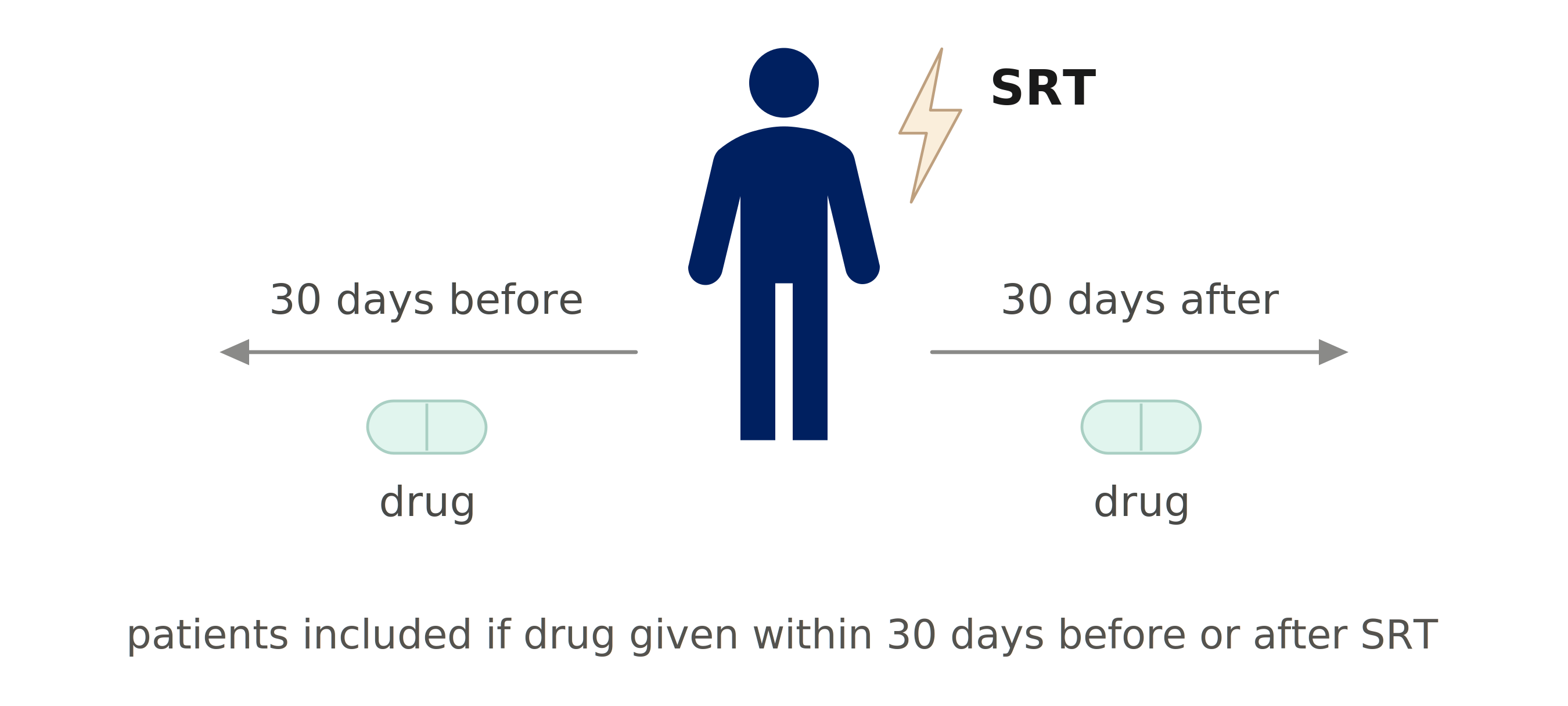
“For anti-vascular endothelial growth factor (VEGF) mAb, fifteen studies[1-15] (six prospective and nine retrospective) included 411 patients treated with this drug within one month of SRT (wmFUP: 26.4mo). Most patients (≥394; 95.9%) received intracranial SRT, and ≥353 received bevacizumab. HgOAEs were reported in 3.3% (10/301), all of whom received intracranial SRT. HgRTAEs occurred in 3.9% (4/102), of whom at least 85 received intracranial SRT.”
References (15)
- 1. Looman EL, Kroeze SGC, Schaule J, et al. Adverse Events After Metastases-Directed Stereotactic Radiotherapy and Biological Cancer Therapy. JAMA Netw Open. 2026/01/02/ 2026;9(1):e2553809. doi:10.1001/jamanetworkopen.2025.53809
- 2. Kroeze SGC, Schaule J, Fritz C, et al. Metastasis directed stereotactic radiotherapy in NSCLC patients progressing under targeted- or immunotherapy: efficacy and safety reporting from the 'TOaSTT' database. Radiat Oncol. Jan 6 2021;16(1):4. doi:10.1186/s13014-020-01730-0
- 3. Chen YL, Huang AP, Wang CC, et al. Peri-radiosurgical administration of bevacizumab improves radiographic response to single and fractionated stereotactic radiosurgery for large brain metastasis. J Neurooncol. Jul 2021;153(3):455–465. doi:10.1007/s11060-021-03782-y
- 4. Clarke J, Neil E, Terziev R, et al. Multicenter, Phase 1, Dose Escalation Study of Hypofractionated Stereotactic Radiation Therapy With Bevacizumab for Recurrent Glioblastoma and Anaplastic Astrocytoma. Int J Radiat Oncol Biol Phys. Nov 15 2017;99(4):797–804. doi:10.1016/j.ijrobp.2017.06.2466
- 5. Conde-Moreno AJ, García-Gómez R, Albert-Antequera M, et al. Fractionated stereotactic radiotherapy plus bevacizumab after response to bevacizumab plus irinotecan as a rescue treatment for high-grade gliomas. Rep Pract Oncol Radiother. May–Jun 2015;20(3):231–8. doi:10.1016/j.rpor.2015.01.004
- 6. Guan Y, Wang C, Zhu H, et al. Hypofractionated Radiosurgery Plus Bevacizumab for Locally Recurrent Brain Metastasis with Previously High-Dose Irradiation. World Neurosurg. Jan 2020;133:e252–e258. doi:10.1016/j.wneu.2019.08.233
- 7. Guinde J, Carron R, Tomasini P, Greillier L, Régis J, Barlesi F. Bevacizumab Plus Radiosurgery for Nonsquamous Non-Small Cell Lung Cancer Patients with Brain Metastases: Safe Combination? World Neurosurg. Nov 2017;107:1047.e1–1047.e4. doi:10.1016/j.wneu.2017.07.185
- 8. Wang Y, Wang E, Pan L, et al. A new strategy of CyberKnife treatment system based radiosurgery followed by early use of adjuvant bevacizumab treatment for brain metastasis with extensive cerebral edema. J Neurooncol. Sep 2014;119(2):369–76. doi:10.1007/s11060-014-1488-0
- 9. Wang Z, Chen H, Chen Q, et al. Efficacy and safety of a "sandwich therapy" based on staged stereotactic radiosurgery and bevacizumab for large brainstem metastases. Clin Neurol Neurosurg. Oct 2023;233:107911. doi:10.1016/j.clineuro.2023.107911
- 10. Wang Z, Chen H, Chen Q, et al. Outcomes of 2-SSRS plus bevacizumab therapy strategy for brainstem metastases (BSM) over 2 cm(3): a multi-center study. Neurosurg Rev. Apr 2 2024;47(1):137. doi:10.1007/s10143-024-02369-1
- 11. Yomo S, Hayashi M. Salvage stereotactic radiosurgery with adjuvant use of bevacizumab for heavily treated recurrent brain metastases: a preliminary report. J Neurooncol. Mar 2016;127(1):119–26. doi:10.1007/s11060-015-2019-3
- 12. Zhang J, Yu J, Yang D, et al. Bevacizumab reduces cerebral radiation necrosis due to stereotactic radiotherapy in non-small cell lung cancer patients with brain metastases: an inverse probability of treatment weighting analysis. Front Immunol. 2024 2024;15:1399613. doi:10.3389/fimmu.2024.1399613
- 13. Zheng S, Ding S, Liu B, et al. Efficacy and safety of online adaptive magnetic resonance-guided fractionated stereotactic radiotherapy for brain metastases in non-small cell lung cancer (GASTO-1075): a single-arm, phase 2 trial. EClinicalMedicine. 2025/04//undefined 2025;82:103189. doi:10.1016/j.eclinm.2025.103189
- 14. Novak Filho JL, Duarte JS, Constanzo F, et al. Radiosurgery for recurrent high-grade gliomas: a critical analysis based on a retrospective single-center series. Neurosurg Rev. 2025/10/27/ 2025;48(1):738. doi:10.1007/s10143-025-03907-1
- 15. Zhou R, Zheng S, Wang D, et al. Efficacy and safety of combining bevacizumab and fractionated stereotactic radiotherapy for extensive brain metastases in patients with non-small cell lung cancer: a prospective phase II study (GASTO-1053). Cancer Commun (Lond). 2025/12//undefined 2025;45(12):1739–1754. doi:10.1002/cac2.70078
Radiobiological rationale for RT–drug interaction
Radiosensitizing via vascular normalization and endothelial VEGFR2/AKT/DNA-PKcs blockade. Endothelial injury is not tumor-restricted, so the mechanism provides a clear rationale for increased vascular normal-tissue side-effects—bowel injury, ischemic colitis, GI perforation/fistula, and impaired healing—particularly where the field includes bowel or previously irradiated tissue, plus a theoretical worsening of radiation lung fibrosis (Hamdeh et al., Alimentary Pharmacology & Therapeutics, 2021, citing Hapani et al.; Makita et al., International Journal of Clinical Oncology, 2026).
The data above refer to patients treated with VEGF mAb as the sole drug class,
excluding any concurrent use of drugs from other groups.
Combination therapy data are available in the section below.
Individual Drugs
Select a drug to view its individual evidence base (drug + SBRT, no other concurrent systemic drugs). Drugs without available data are shown greyed out.